
St. Clair Shores Previous Residents by Era
Past residents are best researched as a sequence of records, each with its own time span and limits. The current parcel record establishes the location. Recorded instruments can identify parties to a transfer. Library and telephone-directory leads may place a name at an address on a publication date. Census, obituary, probate, permit, and city-packet material can then support or challenge the timeline. No reviewed source gives one complete, address-by-address St. Clair Shores history, and the online deed cutoff is not posted.
| Source | Years It Covers | Where Held | What It Shows |
|---|---|---|---|
| St. Clair Shores assessment rolls and BS&A | 20 years of assessment rolls stated | City Assessor, City Hall, and BS&A | Current parcel facts, ownership display, legal description, building facts, and assessment context |
| Macomb Register of Deeds instruments | Online start year not posted | Online registry, public terminals, record books, and microfilm | Recorded parties, instrument type, recording data, legal description, and image availability |
| Mount Clemens City Directory Master Index | 1896–1966 | Mount Clemens Public Library | Nearby city-directory index lead, not a complete St. Clair Shores run |
| Detroit-suburban telephone-directory catalogs | 1975 and 1977 catalog records | University of Michigan cataloged holdings | St. Clair Shores telephone-directory leads; verify the original volume and page |
| Federal census and city permits | Census released after 72 years; permit coverage not posted | Historical repositories and St. Clair Shores Community Development & Inspections | Dated household evidence or a documented structure/improvement event |
Begin with the era you can document. A current address should lead to the parcel and deed trail. A family name from the middle of the twentieth century may be better tested against the Mount Clemens index and released census material. For an older web gap, the fallback chain is the county public terminal, record books or microfilm, library indexes, archive guides, and a direct office inquiry. Note: A party named in a deed is not automatically the person who lived at the property.
Fix the St. Clair Shores Parcel First
Before tracing previous residents, identify the physical parcel rather than relying on a familiar street string. The Macomb GIS User Guide documents property-address, all-known-address, intersection, and tax-ID searches. A result can display the tax ID, property address, community, legal description, and links to local tax-assessing information. The guide’s St. Clair Shores example uses a tax ID format such as 14-22-452-004. That is an example of parcel logic, not a number to reuse for another property.
The city-linked BS&A portal provides assessing, building, current-tax, utility, and other service areas. Its general search guide documents address, name, parcel number, utility-account, and building-department record-number modes. The static research does not establish the exact St. Clair Shores coverage years, historical images, or identical field behavior in every module. Record the assessment year and source date from the live result.
- Parcel or tax ID
- A jurisdictional identifier for a mapped property. It helps tie a map result to an assessor or deed search.
- Situs address
- The physical location of a parcel. It is different from a tax mailing address, which can point elsewhere.
- Legal description
- The subdivision, lot, plat, or other recorded land wording that identifies the property more durably than a normalized street address.
For a past-resident trail, save the parcel ID, situs address, community, and full legal description before moving to the deed index. A map result does not establish a household, and a mailing field should not be treated as the property location without confirmation.
Trace Macomb Deeds for Prior Residents
The Macomb County Register of Deeds records deeds, mortgages, liens, lis pendens, and federal tax liens. Its Search Options describe a basic free online search, advanced subscription searching by address, legal description, parcel, or name, free public terminals, staff searches, and mail requests. Online document copies have a stated charge, and the county lists separate staff-search and page charges. Check the current county page for fees before ordering anything.
The Register of Deeds search-options page documents the channels available when a St. Clair Shores prior-residents trail reaches the deed record.
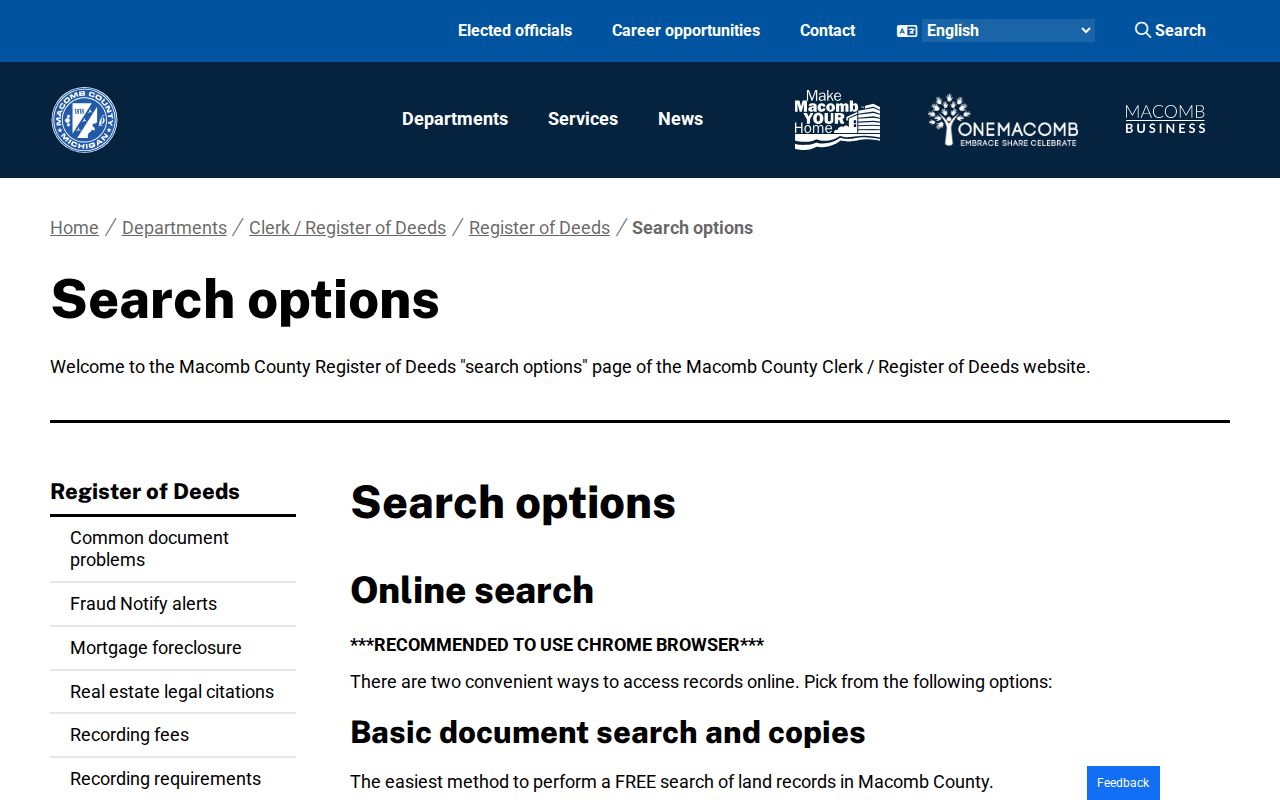
When an online image or date range is unclear, the county’s public terminals, records books, microfilm, staff search, and mail route remain part of the documented research path.
- Get the current parcel number and complete legal description from GIS or the assessor.
- Search the current owner or grantee, parcel, legal description, and address in the Register of Deeds index.
- Read the recorded deed and copy the legal description exactly, including any subdivision, lot, plat liber or page, and exceptions.
- Use the prior grantor or instrument reference to locate the earlier transfer, then continue backward through documented conveyances.
- Check mortgages, discharges, liens, probate transfers, and estate names when the chain changes, and stop at a documented gap rather than an assumed first owner.
- Grantor and grantee
- The grantor transfers an interest. The grantee receives it. The roles are read from the instrument, not inferred from a name alone.
- Chain of title
- The sequence of recorded transfers linked by people, legal descriptions, and prior-instrument references.
- Instrument date
- A deed may have execution and recording dates. Preserve both when the document displays them.
St. Clair Shores Deed Gaps
The county’s online land registry assigns recorded documents a book or page reference and indexes parties and property addresses, but no reviewed county page publishes a single earliest online-image year or a full series-by-series coverage table. That means an empty web search can indicate a missing image, an unscanned book, a different address form, or a name variation. It is not proof that the property had no earlier transfer.
For a missing or older instrument, use the Macomb online land registry for the available index, then move to a public terminal, books, microfilm, a staff search, or a mail request with the record type, party names, approximate recording date, address or legal description, stamped envelope, and payment. The county says it does not provide a large-volume search service. The Land File Office can assist with taxpayer-name or address information, but that is a current lookup, not a title opinion.
Keep a research log with the registry selected, search terms, document number or book and page, instrument type, recording date, parties, legal description, image status, and each missing interval. Macomb County’s early records are also divided among the clerk, Register of Deeds, library, and archives. The Archives of Michigan Macomb County guide is a useful fallback for older record groups.
St. Clair Shores Previous Residents Sources
Ownership and occupancy are different parts of a family or house history. A deed identifies parties to a conveyance. A directory may list a person at an address in the year the volume was published. A released census may help establish a historical household. The St. Clair Shores city directory collections provide the detailed source cautions for nearby index and telephone-directory leads. Use a directory title, year, page, and repository as part of the citation, not as a shorthand for a permanent address.
The official Macomb-area house-history guide points researchers toward directory examples at Mount Clemens, Macomb Daily microfilm and obituary indexes, census material under the 72-year release rule, plats at the Land Files Office, and backward grantor-grantee work. Its cited directory examples are nearby repository leads. They do not show that every St. Clair Shores address appears in each volume. A person missing from one source may have moved, been omitted, used another name form, or been outside the source’s coverage.
The Macomb County genealogy page summarizes the county’s historical vital-record access windows, indexes, identification requirements, and copy routes.
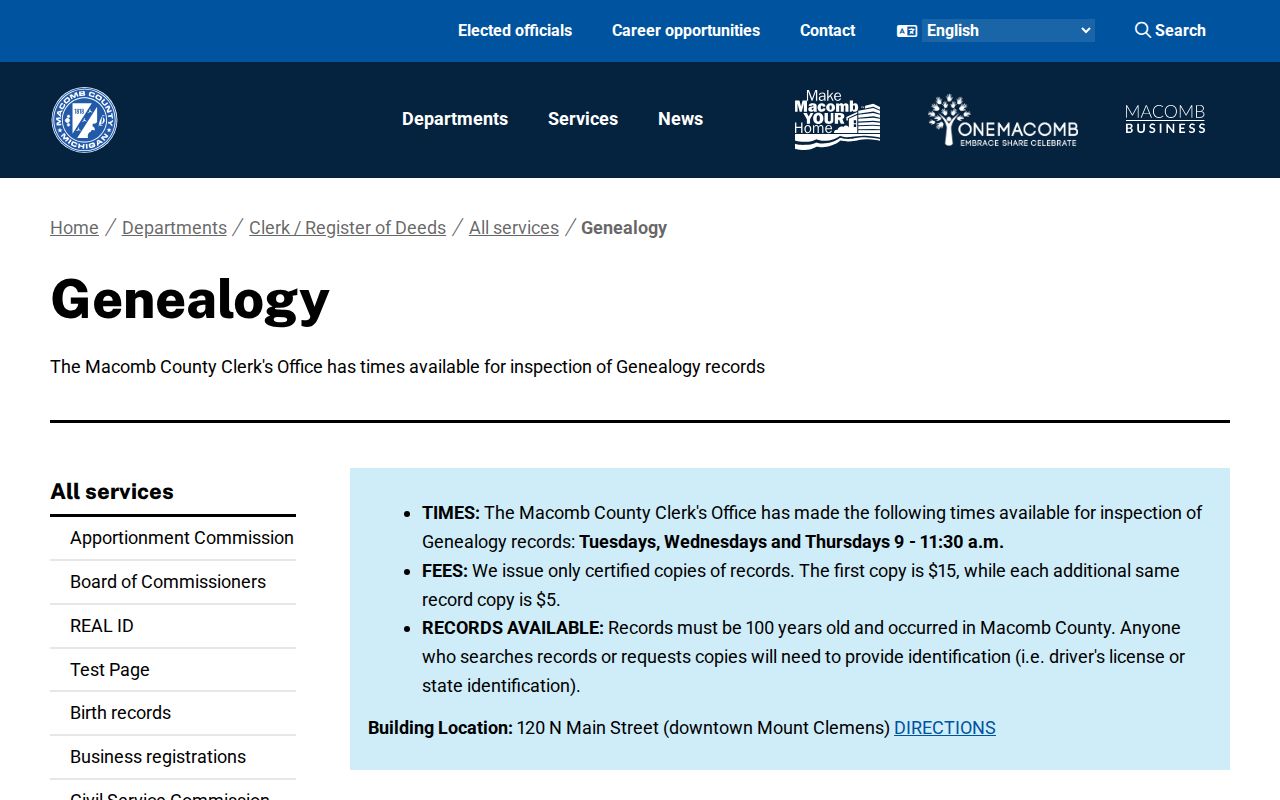
County genealogy inspection has its own age, county-occurrence, identification, fee, and access requirements, so confirm eligibility before requesting a record.
A practical household flow is: dated directory or telephone-book lead, then released census material where available, then an obituary, cemetery, probate, or original newspaper source that can test the identity and date. The Mount Clemens Library indexes include an obituary index reaching 1941 forward with some older material and a Macomb Daily news index from August 1994 forward with stated exclusions. Request the underlying issue or microfilm image.
St. Clair Shores City Records
A dated permit or city packet can help show when a structure or improvement changed, but it does not prove who lived there. The St. Clair Shores Building Department handles building, plumbing, mechanical, electrical, fence, driveway, and related permits. Start with the BS&A Building Department module, then ask Community Development & Inspections about records not available online. Retain the address, record number, date, and source label for any item used in the timeline.
The city’s municipal archive has searchable boards and commissions, council minutes and packets, finance, parks, newsletters, and other categories. It offers keyword, archive, and date-range fields. A city archive packet may mention a property or project without a name index, so search the street, project, subdivision, and historical jurisdiction terms as well as a person’s surname. The historical-marker brochure recommends several supporting documents, including deeds, census material, directories, permits, title abstracts, and Sanborn maps where available.
No reviewed source identified St. Clair Shores-specific Sanborn sheet years or a stable local collection link. The brochure names Sanborn maps as a possible supporting source, but a search result for Saint Clair can concern St. Clair County instead. Confirm the exact city and address with the Library of Congress, local library microfilm, or a Detroit Public Library or university catalog before claiming a map applies to this property.
Lake Township and St. Clair Shores
Records geography matters when following a property backward. St. Clair Shores began with Lake Township and a 1925 village vote, then moved through the 1950 vote for city status and 1951 incorporation. A pre-1951 person, parcel, plat, or city packet may therefore use Lake Township or village wording while a modern portal uses St. Clair Shores. Search both St. Clair and Saint Clair forms and note the historical jurisdiction next to each result.
Mount Clemens has been the Macomb County seat since early county organization, which is why deed, probate, court, county genealogy, and archive work so often routes there. The city’s 75th Anniversary history gives the civic timeline, while county history provides the county-seat context. No authoritative local list of every street renumbering or alias was located. Treat a perceived match as a lead until a deed, plat, city action, directory page, or archive record confirms it.
Close St. Clair Shores Records
The strongest past-resident conclusion says exactly what the source supports. A parcel map supports location and legal description. An assessment record describes current property context. A deed can support a recorded transfer. A directory or telephone book can show a dated listing. Probate, obituary, cemetery, or newspaper material can connect a person and date, but each still needs identity checking. Preserve the source date and avoid turning one type of record into a complete household list.
The Macomb County Heritage Alliance lists microfilm, newspapers, cemetery and obituary indexes, church and funeral records, plats, tract books, local-history files, and St. Clair Shores News as research leads. Confirm the repository, call number, and access conditions before relying on a finding aid. For records not online, the Archives of Michigan, county counters, Mount Clemens Library, and local-history collections provide the documented fallback path.
Lawful use. St. Clair Shores previous-resident research is suited to family history, estate questions, and property history. Do not use a historical lead to track, harass, or harm a living person.